Jump to main content (press Enter)Jump to the footer (press Enter)

Breadcrumbs

  1. Home
  2. Emscherkunstweg
  3. Neustadt

Neustadt

Artists Marta Dyachenko and Julius von Bismarck, together with artistic director Britta Peters, sit in front of Neustadt, a miniature city composed of models of demolished buildings from the Ruhr region.

© Daniel Sadrowski

Address

Landschaftspark Duisburg-Nord
Emscherstraße 71 
47137 Duisburg

Open in Maps

A total of 23 sculptures form a fictitious city composed of various real buildings that have been demolished in the Ruhr region since the turn of the millennium on a scale of 1:25. 

The selection of building types and construction tasks did not follow a strict system, but rather aesthetic, sculptural criteria and the desire to show a cross-section of local urban development. The sculptural installation is deliberately integrated into the seemingly fallow landscape that was actually created as part of the IBA Emscher Park in the 1990s and thus reflects - in addition to remarkable shifts in scale - the relationship between nature and culture. “Neustadt” evokes numerous associations and memories and at the same time invites the viewer to explore both urban planning and ecological issues, which are also reflected in the transformation of the Ruhr area and the Emscher conversion.interventions form an equally hybrid landscape.

Artists

Open Artsit

©Frederike Wetzels

Marta Dyachenko

Marta Dyachenko creates installations with model-like sculptures that critically question the relationship between nature, man and landscape.

View
Open Artsit

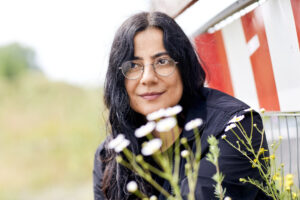
©Daniel Sadrowski

Julius von Bismarck

In his works, Julius von Bismarck examines perception, natural phenomena and urban space at the interface between art and science.
View

Local Blackouts

Lütfiye Güzel

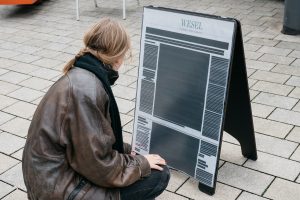
A person in a brown leather jacket looks at a large printed newspaper on a stand with the heading 'Wesel'.

© Daniel Sadrowski

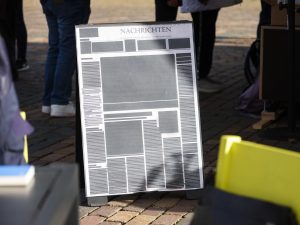
A sign with the word 'NACHRICHTEN' with an abstract newspaper layout with little text.

© Heinrich Holtgreve

Ausgangsmaterial ist ein besonders kurzweiliges Format aus dem Alltag: die Tageszeitung. Lütfiye Güzel, Poetin aus Duisburg und Vertreterin eines konsequent selbstverlegten, körpernahen Schreibens, lässt sich für die Grand Snail Tour von Projektpartner*innen und Passant*innen Lokalzeitungen und -beilagen aus den zu bereisenden Städten zusenden. Aus diesen Dokumenten erzeugt Güzel durch gezieltes Ausstreichen und Schwärzen von Textpassagen insgesamt 53 Gedichte — Local Blackouts —, die auf Aufstellern an jeder Station veröffentlicht werden.

Die Methode der Blackout Poetry ist eine Form der Found Poetry und wird bei Güzel zum politischen Akt. Das Schwärzen zitiert die Logik der Zensur, kehrt sie aber um, denn das unkenntlich Machen hat nicht Unterdrückung, sondern Verdichtung zum Ziel: Was bleibt, wenn der redaktionelle Lärm verschwindet? Lyrische Miniaturen, die in ihrer Knappheit dem Haiku ähnlich ist. Güzels Entscheidung, diese Textarbeiten im öffentlichen Raum zu zeigen, stellt zudem implizit die Frage: Für wen werden solche Texte geschrieben, und wer kommt darin vor?

Lokalzeitungen sind ein ambivalentes Medium. Sie fördern und informieren Nachbarschaften jenseits von Social Media — doch die Sprache und Nachrichtenauswahl ist häufig hetzerisch und vereinfachend. Tatsache ist, dass Lokalzeitungen an Bedeutung und finanzielle Unterstützung verlieren. Güzels Aneignung bewahrt und befragt dieses Erbe zugleich. Präsentiert auf herkömmlichen Presseaufstellern verleiht ihre Arbeit der Grand Snail Tour ein vertrautes Erscheinungsbild von regionaler Kultur und überführt diese gleichzeitig in die poetische Abstraktion.

Artist

Open Artsit

©Ben Knabe

Lütfiye Güzel

Lütfiye Güzel is a poet and has been publishing poems under her own label go-güzel-publishing since 2014.

View