Jump to main content (press Enter)Jump to the footer (press Enter)

Breadcrumbs

  1. Home
  2. Emscherkunstweg
  3. Neustadt

Neustadt

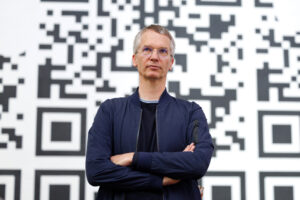
Artists Marta Dyachenko and Julius von Bismarck, together with artistic director Britta Peters, sit in front of Neustadt, a miniature city composed of models of demolished buildings from the Ruhr region.

© Daniel Sadrowski

Address

Landschaftspark Duisburg-Nord
Emscherstraße 71 
47137 Duisburg

Open in Maps

A total of 23 sculptures form a fictitious city composed of various real buildings that have been demolished in the Ruhr region since the turn of the millennium on a scale of 1:25. 

The selection of building types and construction tasks did not follow a strict system, but rather aesthetic, sculptural criteria and the desire to show a cross-section of local urban development. The sculptural installation is deliberately integrated into the seemingly fallow landscape that was actually created as part of the IBA Emscher Park in the 1990s and thus reflects - in addition to remarkable shifts in scale - the relationship between nature and culture. “Neustadt” evokes numerous associations and memories and at the same time invites the viewer to explore both urban planning and ecological issues, which are also reflected in the transformation of the Ruhr area and the Emscher conversion.interventions form an equally hybrid landscape.

Artists

Open Artsit

©Frederike Wetzels

Marta Dyachenko

Marta Dyachenko creates installations with model-like sculptures that critically question the relationship between nature, man and landscape.

View
Open Artsit

©Daniel Sadrowski

Julius von Bismarck

In his works, Julius von Bismarck examines perception, natural phenomena and urban space at the interface between art and science.
View

Choir of Missed Connections

Aram Bartholl

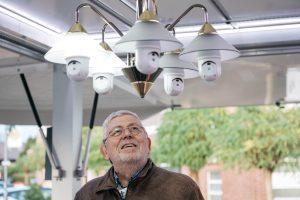
A man looks at a futuristic lamp with integrated surveillance cameras.

© Daniel Sadrowski

© Daniel Sadrowski

Wir stehen unter einem Kronleuchter, der statt Kerzen fünf 360°-Kameras in Glühbirnenform trägt. Diese suchen pausenlos nach einer Internetverbindung, aus der Audioschleife von Verbindungsaufbau und Reset – „Entering peering mode“ und „Power on!" – wird ein Chor aus Fehlermeldungen, der uns im Grand Snail Tour Trailer umgibt.

Aram Bartholl – Medienkünstler, Aktivist und Professor – stellt seit Dekaden unser Medienverhalten und die Ökonomien sozialer Netzwerke zur Diskussion. Im heutigen Internet sieht er die zentralen Probleme im Rückzug in private und kommerzielle Nutzung, in Überwachung, Manipulation und den endlosen Datenfluten. Dabei ist Kontrolle durch Licht kein neues Phänomen: Straßenbeleuchtung dienten nicht zuletzt dazu, Sichtbarkeit im öffentlichen Raum herzustellen, um längere Arbeitszeiten zu ermöglichen, Bewegungen zu erfassen, Menschen zu kontrollieren. Geprägt von seiner Nähe zum Chaos Computer Club, überführt Bartholl Lücken und Absurditäten des digitalen Alltags in Objekte und Interventionen. Mit Dead Drops (seit 2010) zementierte er USB-Sticks in Mauerwerke – Speicher für einen anonyme Datenaustausch ohne Cloud, ohne Algorithmus, ohne Konzern. Für Skulptur Projekte Münster entwickelte Bartholl 2017 thermoelektrische Installationen an historischen Orten der Stadt, die das Feuer als ursprüngliches Kommunikationsmedium in Energie umwandelten: Ein ofenbeheizter Offline-Router am Fernmeldeturm, lagerfeuergespeiste Ladestationen für Mobiltelefone am Pumpenhaus – und einen Kronleuchter aus teelichtbetriebenen LED-Lampen in der Schlossunterführung. 

Choir of Missed Connections zieht nun als Soundskulptur durch abgelegene Kleinstädte, sucht Verbindungen – und wird im kommunikativen Sinne vielleicht auf unerwartete Weise fündig.

Artist

Open Artsit

©Friso Gentsch

Aram Bartholl

In his sculptural works and workshops, Aram Bartholl explores digital media, surveillance and platform capitalism in public space.

View