Jump to main content (press Enter)Jump to the footer (press Enter)

Breadcrumbs

  1. Home
  2. Emscherkunstweg
  3. Neustadt

Neustadt

Artists Marta Dyachenko and Julius von Bismarck, together with artistic director Britta Peters, sit in front of Neustadt, a miniature city composed of models of demolished buildings from the Ruhr region.

© Daniel Sadrowski

Address

Landschaftspark Duisburg-Nord
Emscherstraße 71 
47137 Duisburg

Open in Maps

A total of 23 sculptures form a fictitious city composed of various real buildings that have been demolished in the Ruhr region since the turn of the millennium on a scale of 1:25. 

The selection of building types and construction tasks did not follow a strict system, but rather aesthetic, sculptural criteria and the desire to show a cross-section of local urban development. The sculptural installation is deliberately integrated into the seemingly fallow landscape that was actually created as part of the IBA Emscher Park in the 1990s and thus reflects - in addition to remarkable shifts in scale - the relationship between nature and culture. “Neustadt” evokes numerous associations and memories and at the same time invites the viewer to explore both urban planning and ecological issues, which are also reflected in the transformation of the Ruhr area and the Emscher conversion.interventions form an equally hybrid landscape.

Artists

Open Artsit

©Frederike Wetzels

Marta Dyachenko

Marta Dyachenko creates installations with model-like sculptures that critically question the relationship between nature, man and landscape.

View
Open Artsit

©Daniel Sadrowski

Julius von Bismarck

In his works, Julius von Bismarck examines perception, natural phenomena and urban space at the interface between art and science.
View

7000 Palmen

Cosima von Bonin

© Daniel Sadrowski 

Die Palme ist Siegeszeichen und Strandbar-Logo, zentrales Motiv in der Bibel sowie der Urlaubswerbung, Wappenpflanze unzähliger Nationalflaggen und vielseitig genutzter/vielfach verschickter Emoji. Cosima von Bonin arbeitet mit dem populären Symbol als stilisierte Konturform. Sie nimmt dabei offensichtlich Bezug auf Beuys soziale Plastik 7000 Eichen - Stadtverwaldung statt Stadtverwaltung, für die er 1982 für die documenta 7 auf dem Vorplatz des Fridericianum in Kassel 7000 Basaltstelen aufschüttete, die mit jeder in der Stadt neu gepflanzten Eiche abgetragen wurden: Je mehr Bäume in Kassel gepflanzt wurden, desto kleiner wurde die Plastik. Noch heute sind die „Beuys-Eichen“ durch die jeweils daneben eingelassenen Stelen gut zu erkennen.  

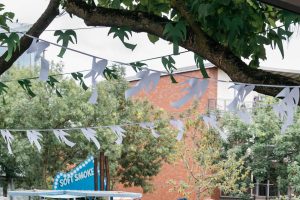
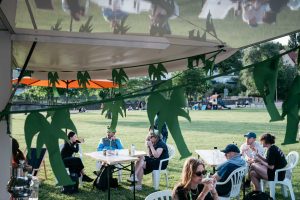
Die Künstlerin vervielfältigte die Pflanze 7000-fach als luftige Girlande in grün und weiß. Die Besitzer*innen der kostenlosen Edition – ob Museum, Schule oder Sportverein – können damit öffentliche Räume markieren. Die Methode der Vereinfachung ist uns auch aus anderen künstlerischen Arbeiten von Bonins bekannt: Sie fragmentiert, abstrahiert und erzeugt damit eine Anziehungskraft zwischen Wiedererkennung und Verfremdung. Generell ist Textil ein zentrales Material, beispielweise als collagierte Stoffbilder, übergroße Kleidungsstücke, Wandteppiche oder Skulpturen, die nach dem Vorbild bekannter Comicfiguren entstehen, oder Plüschtiere abbilden. 

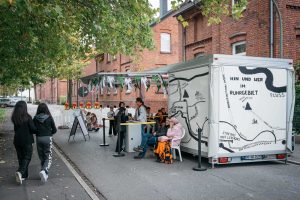
Von Bonin wurde international und mit Einzelausstellungen im Museum Ludwig Köln, im MUMOK Wien, im SculptureCenter New York und zuletzt im Mudam Luxemburg gewürdigt und nahm 2007 an der documenta 12 sowie 2022 an der Biennale di Venezia teil. Als fester Bestandteil der Sammlung betont 7000 Palmen den öffentlichen Charakter der Grand Snail Trailer und schmückt den Trailer als willkommen heißenden Ort zwischen Marktstand, Vereinsheim und Kunstprojekt. 

Artist

Open Artsit

© Simone Junker

Cosima von Bonin

Cosima von Bonin is one of the most influential artists of her generation. She participated in documenta 12 in 2007 and the Venice Biennale in 2022.

View