Jump to main content (press Enter)Jump to the footer (press Enter)

Breadcrumbs

  1. Home
  2. Emscherkunstweg
  3. Königsgrube

Königsgrube

© Henning Rogge

© Henning Rogge

© Henning Rogge

Address

Hofstraße 24
44651 Herne

Open in Maps

A former pumping station of a disused colliery becomes an installation, the name remains and sounds promising: Königsgrube. Markus Jeschaunig's work, in which he transforms fragments of the demolished building into a hybrid landscape, is characterised by past and future.

From 1860 to 1967, coal mining at the Königsgrube colliery in Herne-Röhlinghausen was extremely productive, then the black gold was extracted, leaving the earth depleted and perforated with subsidence of up to ten metres. The pumping station had the task of channeling the waste water from the neighbouring communities into the Hüller Bach and from there into the Emscher. With the end of coal mining, underground disposal became possible and the pumping station was decommissioned.

The pumping station is now being demolished. Artist Markus Jeschaunig is creating an installation on the partially backfilled foundations that sculpturally integrates various elements of the building: Part of a staircase will be preserved, three pipes will form a solar-powered fountain from which drops of water and sounds can be heard. A quarry forest is being created, a biotope made up of six black alder trees that like it wet and are reminiscent of the floodplain landscapes along the Emscher in pre-industrial times. On the paved forecourt, rainwater can be collected in a cistern via gutters and, together with a photovoltaic pergola, enables completely self-sufficient operation.

As an artistically remodelled ruin, Jeschaunig's work points to both the great technologies and the enormous ecological destruction that mining brought with it, and at the same time shows a way in which new life and climate-positive places can be created in the city.

Artist

Open Artsit

©Daniel Sadrowski

Markus Jeschaunig

Markus Jeschaunig works as an artist and architect, his projects combine art, natural sciences, ecology and activism.

View

Dates

  • Open Event
    Group of cyclists on a tour along the Emscherkunstweg. The cyclists ride on a paved path next to a river, passing under a highway bridge, surrounded by green scenery.

    © Daniel Sadrowski

    So., 30.3.25, 12:30–15 hView

    Bike Tour to the Opening of Königsgrube

  • Open Event
    The former pumping station Königsgrube by Markus Jeschaunig is captured in a winter setting, highlighting its green industrial structures and historical significance.

    © Daniel Sadrowski

    So., 30.3.25, 15 hView

    Opening Königsgrube

Local Blackouts

Lütfiye Güzel

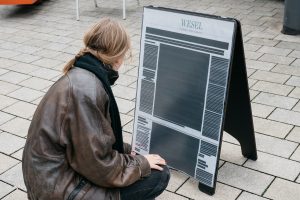
A person in a brown leather jacket looks at a large printed newspaper on a stand with the heading 'Wesel'.

© Daniel Sadrowski

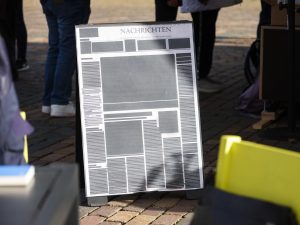
A sign with the word 'NACHRICHTEN' with an abstract newspaper layout with little text.

© Heinrich Holtgreve

Ausgangsmaterial ist ein besonders kurzweiliges Format aus dem Alltag: die Tageszeitung. Lütfiye Güzel, Poetin aus Duisburg und Vertreterin eines konsequent selbstverlegten, körpernahen Schreibens, lässt sich für die Grand Snail Tour von Projektpartner*innen und Passant*innen Lokalzeitungen und -beilagen aus den zu bereisenden Städten zusenden. Aus diesen Dokumenten erzeugt Güzel durch gezieltes Ausstreichen und Schwärzen von Textpassagen insgesamt 53 Gedichte — Local Blackouts —, die auf Aufstellern an jeder Station veröffentlicht werden.

Die Methode der Blackout Poetry ist eine Form der Found Poetry und wird bei Güzel zum politischen Akt. Das Schwärzen zitiert die Logik der Zensur, kehrt sie aber um, denn das unkenntlich Machen hat nicht Unterdrückung, sondern Verdichtung zum Ziel: Was bleibt, wenn der redaktionelle Lärm verschwindet? Lyrische Miniaturen, die in ihrer Knappheit dem Haiku ähnlich ist. Güzels Entscheidung, diese Textarbeiten im öffentlichen Raum zu zeigen, stellt zudem implizit die Frage: Für wen werden solche Texte geschrieben, und wer kommt darin vor?

Lokalzeitungen sind ein ambivalentes Medium. Sie fördern und informieren Nachbarschaften jenseits von Social Media — doch die Sprache und Nachrichtenauswahl ist häufig hetzerisch und vereinfachend. Tatsache ist, dass Lokalzeitungen an Bedeutung und finanzielle Unterstützung verlieren. Güzels Aneignung bewahrt und befragt dieses Erbe zugleich. Präsentiert auf herkömmlichen Presseaufstellern verleiht ihre Arbeit der Grand Snail Tour ein vertrautes Erscheinungsbild von regionaler Kultur und überführt diese gleichzeitig in die poetische Abstraktion.

Artist

Open Artsit

©Ben Knabe

Lütfiye Güzel

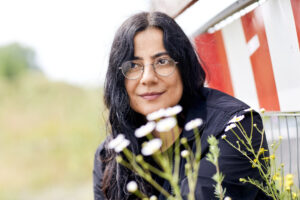
Lütfiye Güzel is a poet and has been publishing poems under her own label go-güzel-publishing since 2014.

View