Jump to main content (press Enter)Jump to the footer (press Enter)

Breadcrumbs

  1. Home
  2. Emscherkunstweg
  3. Königsgrube

Königsgrube

© Henning Rogge

© Henning Rogge

© Henning Rogge

Address

Hofstraße 24
44651 Herne

Open in Maps

A former pumping station of a disused colliery becomes an installation, the name remains and sounds promising: Königsgrube. Markus Jeschaunig's work, in which he transforms fragments of the demolished building into a hybrid landscape, is characterised by past and future.

From 1860 to 1967, coal mining at the Königsgrube colliery in Herne-Röhlinghausen was extremely productive, then the black gold was extracted, leaving the earth depleted and perforated with subsidence of up to ten metres. The pumping station had the task of channeling the waste water from the neighbouring communities into the Hüller Bach and from there into the Emscher. With the end of coal mining, underground disposal became possible and the pumping station was decommissioned.

The pumping station is now being demolished. Artist Markus Jeschaunig is creating an installation on the partially backfilled foundations that sculpturally integrates various elements of the building: Part of a staircase will be preserved, three pipes will form a solar-powered fountain from which drops of water and sounds can be heard. A quarry forest is being created, a biotope made up of six black alder trees that like it wet and are reminiscent of the floodplain landscapes along the Emscher in pre-industrial times. On the paved forecourt, rainwater can be collected in a cistern via gutters and, together with a photovoltaic pergola, enables completely self-sufficient operation.

As an artistically remodelled ruin, Jeschaunig's work points to both the great technologies and the enormous ecological destruction that mining brought with it, and at the same time shows a way in which new life and climate-positive places can be created in the city.

Artist

Open Artsit

©Daniel Sadrowski

Markus Jeschaunig

Markus Jeschaunig works as an artist and architect, his projects combine art, natural sciences, ecology and activism.

View

Dates

  • Open Event
    Group of cyclists on a tour along the Emscherkunstweg. The cyclists ride on a paved path next to a river, passing under a highway bridge, surrounded by green scenery.

    © Daniel Sadrowski

    So., 30.3.25, 12:30–15 hView

    Bike Tour to the Opening of Königsgrube

  • Open Event
    The former pumping station Königsgrube by Markus Jeschaunig is captured in a winter setting, highlighting its green industrial structures and historical significance.

    © Daniel Sadrowski

    So., 30.3.25, 15 hView

    Opening Königsgrube

7000 Palmen

Cosima von Bonin

© Daniel Sadrowski 

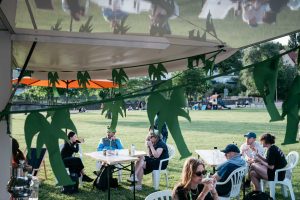
Die Palme ist Siegeszeichen und Strandbar-Logo, zentrales Motiv in der Bibel sowie der Urlaubswerbung, Wappenpflanze unzähliger Nationalflaggen und vielseitig genutzter/vielfach verschickter Emoji. Cosima von Bonin arbeitet mit dem populären Symbol als stilisierte Konturform. Sie nimmt dabei offensichtlich Bezug auf Beuys soziale Plastik 7000 Eichen - Stadtverwaldung statt Stadtverwaltung, für die er 1982 für die documenta 7 auf dem Vorplatz des Fridericianum in Kassel 7000 Basaltstelen aufschüttete, die mit jeder in der Stadt neu gepflanzten Eiche abgetragen wurden: Je mehr Bäume in Kassel gepflanzt wurden, desto kleiner wurde die Plastik. Noch heute sind die „Beuys-Eichen“ durch die jeweils daneben eingelassenen Stelen gut zu erkennen.  

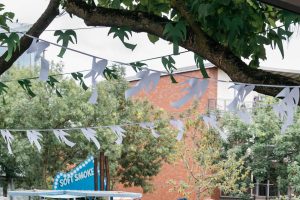
Die Künstlerin vervielfältigte die Pflanze 7000-fach als luftige Girlande in grün und weiß. Die Besitzer*innen der kostenlosen Edition – ob Museum, Schule oder Sportverein – können damit öffentliche Räume markieren. Die Methode der Vereinfachung ist uns auch aus anderen künstlerischen Arbeiten von Bonins bekannt: Sie fragmentiert, abstrahiert und erzeugt damit eine Anziehungskraft zwischen Wiedererkennung und Verfremdung. Generell ist Textil ein zentrales Material, beispielweise als collagierte Stoffbilder, übergroße Kleidungsstücke, Wandteppiche oder Skulpturen, die nach dem Vorbild bekannter Comicfiguren entstehen, oder Plüschtiere abbilden. 

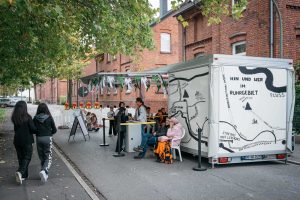
Von Bonin wurde international und mit Einzelausstellungen im Museum Ludwig Köln, im MUMOK Wien, im SculptureCenter New York und zuletzt im Mudam Luxemburg gewürdigt und nahm 2007 an der documenta 12 sowie 2022 an der Biennale di Venezia teil. Als fester Bestandteil der Sammlung betont 7000 Palmen den öffentlichen Charakter der Grand Snail Trailer und schmückt den Trailer als willkommen heißenden Ort zwischen Marktstand, Vereinsheim und Kunstprojekt. 

Artist

Open Artsit

© Simone Junker

Cosima von Bonin

Cosima von Bonin is one of the most influential artists of her generation. She participated in documenta 12 in 2007 and the Venice Biennale in 2022.

View