Jump to main content (press Enter)Jump to the footer (press Enter)

Breadcrumbs

  1. Home
  2. Artists
  3. Profile

Asad Raza

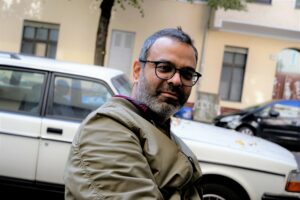
Portrait of artist Asad Raza, who creates interdisciplinary works between art, science, and philosophy, wearing glasses and an olive-green jacket in an urban setting.

© Daniel Sadrowski

In his work artist Asad Raza (*1974 in Buffalo, USA) often explores dialogic exchange and rejects disciplinary boundaries. Raza conceives of art as a metabolic, active experience combining human, non-human beings, and objects in his projects. Often working outside the museum context and referencing intimate spaces, he developed works such as The Bedroom at the 2018 Lahore Biennale, for which he created a temporary space where young people could sing and play chess with visitors or untitled (plot for a dialogue) (2017), where visitors were invited to play tennis in a church from the 16th century in Milan. For home show (2015), which took place at his private apartment in New York, Raza invited artists and friends to intervene in his life. Together with Hans Ulrich Obrist Asad Raza currently curates a series of exhibitions that is inspired by the philosopher and poet Édouard Glissant. 

Invited by Urbane Künste Ruhr as their contribution to Ruhrtriennale 2021, Raza shows his installation Absorption in Essen, in which a team of cultivators processes 200 tons of soil into Neosoil. 
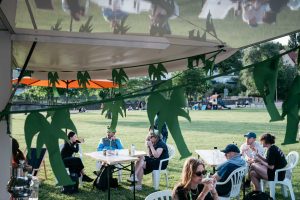
7000 Palmen

Cosima von Bonin

© Daniel Sadrowski 

Die Palme ist Siegeszeichen und Strandbar-Logo, zentrales Motiv in der Bibel sowie der Urlaubswerbung, Wappenpflanze unzähliger Nationalflaggen und vielseitig genutzter/vielfach verschickter Emoji. Cosima von Bonin arbeitet mit dem populären Symbol als stilisierte Konturform. Sie nimmt dabei offensichtlich Bezug auf Beuys soziale Plastik 7000 Eichen - Stadtverwaldung statt Stadtverwaltung, für die er 1982 für die documenta 7 auf dem Vorplatz des Fridericianum in Kassel 7000 Basaltstelen aufschüttete, die mit jeder in der Stadt neu gepflanzten Eiche abgetragen wurden: Je mehr Bäume in Kassel gepflanzt wurden, desto kleiner wurde die Plastik. Noch heute sind die „Beuys-Eichen“ durch die jeweils daneben eingelassenen Stelen gut zu erkennen.  

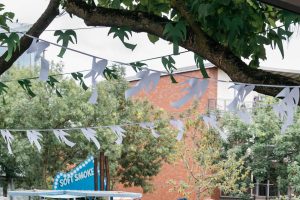
Die Künstlerin vervielfältigte die Pflanze 7000-fach als luftige Girlande in grün und weiß. Die Besitzer*innen der kostenlosen Edition – ob Museum, Schule oder Sportverein – können damit öffentliche Räume markieren. Die Methode der Vereinfachung ist uns auch aus anderen künstlerischen Arbeiten von Bonins bekannt: Sie fragmentiert, abstrahiert und erzeugt damit eine Anziehungskraft zwischen Wiedererkennung und Verfremdung. Generell ist Textil ein zentrales Material, beispielweise als collagierte Stoffbilder, übergroße Kleidungsstücke, Wandteppiche oder Skulpturen, die nach dem Vorbild bekannter Comicfiguren entstehen, oder Plüschtiere abbilden. 

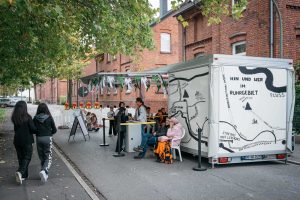
Von Bonin wurde international und mit Einzelausstellungen im Museum Ludwig Köln, im MUMOK Wien, im SculptureCenter New York und zuletzt im Mudam Luxemburg gewürdigt und nahm 2007 an der documenta 12 sowie 2022 an der Biennale di Venezia teil. Als fester Bestandteil der Sammlung betont 7000 Palmen den öffentlichen Charakter der Grand Snail Trailer und schmückt den Trailer als willkommen heißenden Ort zwischen Marktstand, Vereinsheim und Kunstprojekt. 

Artist

Open Artsit

© Simone Junker

Cosima von Bonin

Cosima von Bonin is one of the most influential artists of her generation. She participated in documenta 12 in 2007 and the Venice Biennale in 2022.

View